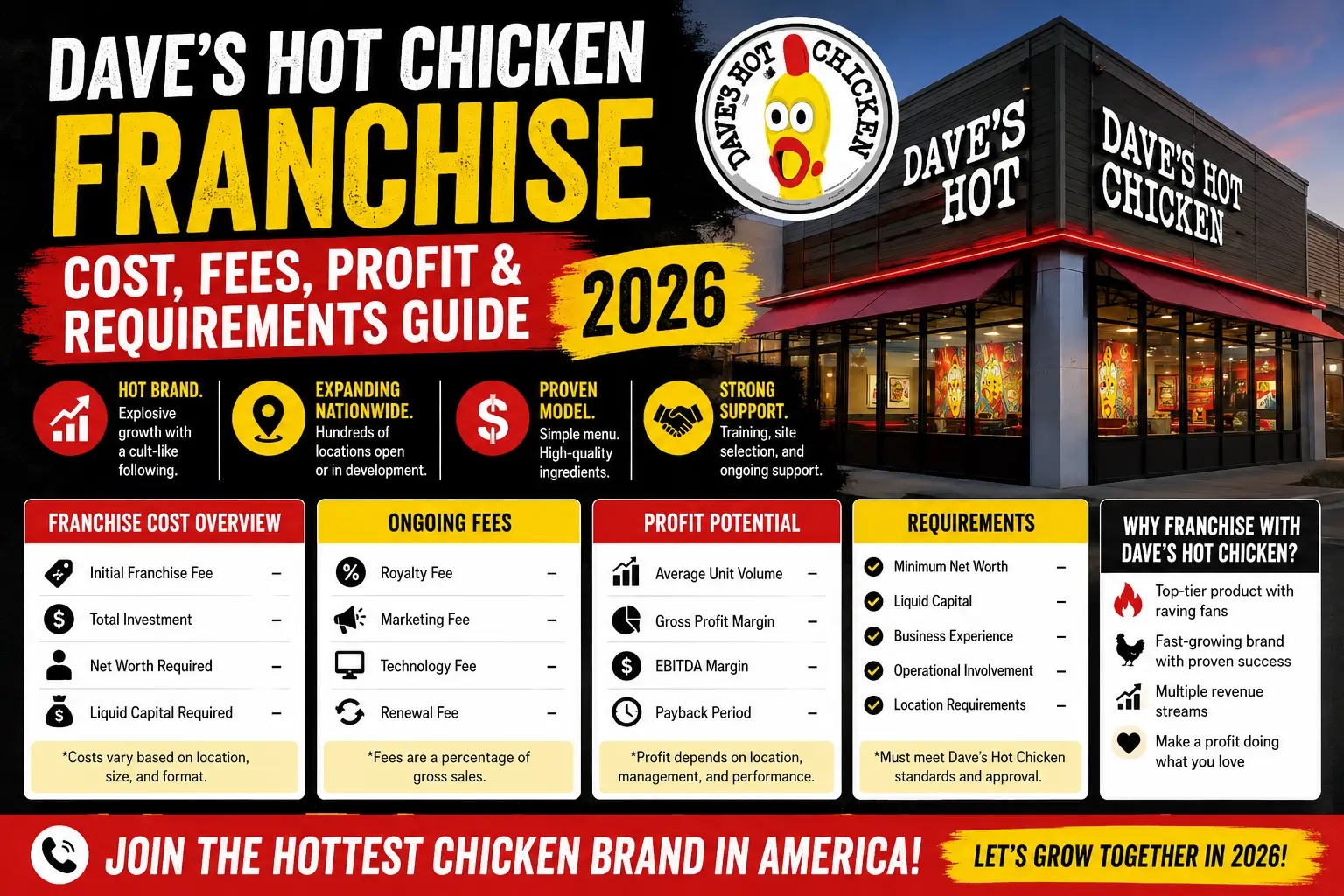
Dave’s Hot Chicken Franchise Cost, Fees, Profit & Requirements Guide 2026
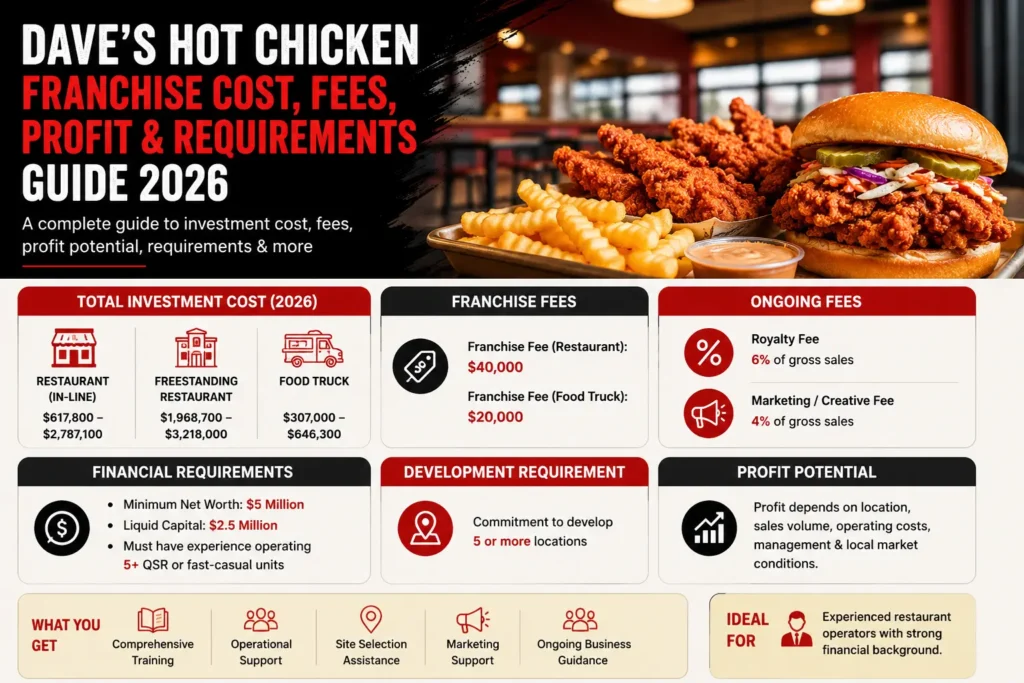
Starting a Dave’s Hot Chicken franchise in 2026 requires a large investment because the brand focuses on experienced multi-unit restaurant operators. The total startup cost usually depends on the restaurant format, location, construction expenses, and local market conditions. The estimated investment for an in-line or endcap restaurant ranges from around $617,800 to $2,170,000, while a freestanding restaurant may cost between $989,800 and $3,218,000. For investors looking for a smaller option, the Dave’s Hot Chicken food truck model may require approximately $208,150 to $544,500.
Dave’s Hot Chicken: Brand Snapshot
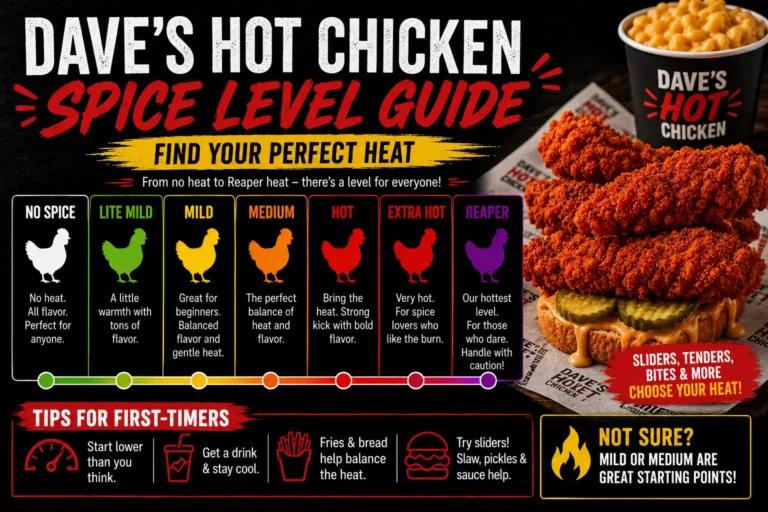
Before getting into costs and requirements, it helps to know a bit about how the brand started. Dave’s Hot Chicken was founded by Dave Kopushyan, Arman Oganesyan, and brothers Tommy and Gary Rubenyan, reportedly beginning as a small pop-up in a Los Angeles parking lot around 2017–2018. The company began awarding franchise locations around 2019 and has since grown into a nationwide fast-casual chain. The brand is best known for its Nashville-style tenders and sliders, usually offered across roughly seven spice levels, ranging from a mild “No Spice” option up to an extremely hot tier often nicknamed “The Reaper.” This spice-level system has become one of the brand’s biggest identity markers and a major reason for its social media popularity.
The system has expanded quickly in a short period, and the exact number of open locations (both franchised and company-owned) can change frequently as new restaurants open. Prospective franchisees should always confirm the current unit count directly with the franchisor or the latest Franchise Disclosure Document (FDD), since third-party figures can go out of date fast. Some industry reports also note that the brand’s ownership includes private equity backing, which can bring more structured franchise development processes but may also mean ownership or terms shift over time — another reason to review the most current FDD before committing.
Over the years, Dave’s Hot Chicken has picked up recognition from several restaurant industry publications for its rapid growth and “hot concept” status, which has helped fuel investor interest. The brand has also built multiple revenue streams beyond in-store dining, including branded merchandise and online/delivery ordering, which can support overall unit economics alongside core food sales.
Franchise Requirements
Unlike smaller food franchises, Dave’s Hot Chicken mainly looks for experienced restaurant operators with strong financial backgrounds. The company prefers franchise groups that already manage multiple quick-service or fast-casual restaurants.
To qualify for a Dave’s Hot Chicken franchise in 2026, applicants generally need:
| Requirement | Details |
| Minimum Net Worth | Around $5 Million |
| Liquid Capital | Around $2.5 Million |
| Restaurant Experience | Must operate 5+ QSR or fast-casual units |
| Domestic Development Commitment | 5 or more locations |
| International Development Commitment | Typically a higher minimum (reported around 30+ locations) for international territories |
| Site Size (typical) | Around 1,000–2,500 sq ft, varies by format and market |
| Lease Term (typical) | Usually 10–15 years, subject to landlord and market terms |
It’s also worth understanding what kind of ownership role the franchise expects. Dave’s Hot Chicken is generally described as a hands-on, owner-operator model rather than a semi-absentee or passive-income opportunity — franchisees (or their designated Operating Principal) are expected to be actively involved in running the business, not just funding it. It is also not typically offered as a home-based or master-franchise opportunity, so applicants should plan for direct, on-site involvement in daily operations, especially in the early stages of ownership.
The company also expects franchisees to:
Because of these strict requirements, Dave’s Hot Chicken is usually not considered a beginner-friendly franchise. It is better suited for experienced restaurant investors who already understand operations, staffing, food costs, and multi-location management.
Territory Protection
Franchise agreements can vary in how much territorial protection they offer. In some cases, a franchisee may be granted a defined territory where the franchisor agrees not to open or license another location for the length of the agreement. In other cases, the agreement may only cover the specific restaurant address, with no wider territorial exclusivity. This detail is usually spelled out in the franchise agreement and FDD, so applicants should confirm which option applies to their specific market before signing.
How Much Does It Cost to Start a Franchise?
Opening a Dave’s Hot Chicken franchise requires a major financial investment.
Total Investment Range
Depending on the restaurant type and location, the estimated investment can range from:
| Franchise Type | Estimated Investment |
| In-Line / Endcap Restaurant | $617,800 – $2,170,000 |
| Freestanding Restaurant | $989,800 – $3,218,000 |
| Food Truck | $208,150 – $544,500 |
Some older franchise estimates also place the investment range between approximately $619,800 and $1,963,000, depending on location and market conditions. Estimates can differ between sources and FDD versions, so figures should always be treated as approximate until confirmed against the most recent official FDD.
Prime city locations usually cost more because of:
Dave’s Hot Chicken Franchise Fee
The company charges an upfront franchise fee when signing the franchise agreement.
| Franchise Type | Franchise Fee |
| Restaurant | $40,000 |
| Food Truck | $20,000 |
This fee gives franchisees the right to operate under the Dave’s Hot Chicken brand and business system. In a multi-unit development agreement, this fee is typically charged separately for each location as it is developed, rather than as a single one-time payment for the whole territory.
Ongoing Franchise Fees
Like most restaurant franchises, owners must also pay ongoing fees.
| Fee Type | Amount |
| Royalty Fee | Around 5%–6% of gross sales (can vary by agreement) |
| Creative / Marketing Fund | Around 2%–4% of gross sales (can vary by agreement) |
This means franchisees typically pay somewhere around 7%–10% of gross sales in combined royalty and marketing fees before covering:
Exact percentages can differ between franchise agreements and FDD versions, so applicants should always confirm the current fee structure directly with the franchisor.
Franchise agreements in this industry commonly run for a fixed term (often cited in the 10–20 year range for QSR/fast-casual brands), with renewal typically requiring a separate fee and meeting current brand standards at the time of renewal. Franchisees should confirm the exact term length and renewal conditions in their specific agreement.
Why Startup Costs Vary by Location
One of the biggest factors affecting franchise cost is real estate.
For example:
Other cost factors include:
Restaurant Cost Breakdown
In-Line or Endcap Restaurant
| Category | Estimated Cost |
| Dave’s Hot Chicken Franchise Fee | $40,000 |
| Construction / Build-Out | $275,000 – $980,000 |
| Equipment | $110,000 – $370,000 |
| Artwork & Graffiti Design | $30,000 – $125,000 |
| Signage | $17,000 – $77,000 |
| Inventory & Supplies | $20,000 – $40,000 |
| Additional Funds (3 Months) | $16,300 – $48,000 |
Freestanding Restaurant
| Category | Estimated Cost |
| Franchise Fee | $40,000 |
| Construction / Build-Out | $542,000 – $2,000,000 |
| Equipment | $214,000 – $370,000 |
| Artwork & Graffiti Design | $30,000 – $125,000 |
| Signage | $7,000 – $85,000 |
| Inventory & Supplies | $20,000 – $40,000 |
| Additional Funds (3 Months) | $16,300 – $48,000 |
Food Truck Cost
Some investors choose the food truck model because it requires less capital.
| Category | Estimated Cost |
| Franchise Fee | $20,000 |
| Food Truck Purchase | $75,000 – $125,000 |
| Truck Retrofit | $50,000 – $250,000 |
| Equipment | $20,000 – $40,000 |
| Inventory & Supplies | $5,000 – $10,000 |
| Additional Funds | $4,000 – $12,000 |
Although cheaper than full restaurants, food trucks must still follow company branding and operational standards.
Profit Potential: What the Data Suggests
One of the most common questions investors ask is how much a Dave’s Hot Chicken location can actually earn. Some third-party franchise research sites report average unit volume (AUV) figures loosely in the range of roughly $1.5 million to over $3 million per year, though these numbers can vary a lot by market, size, and how established a location is.
Important disclaimer: Dave’s Hot Chicken does not appear to publish an official financial performance representation (commonly known as “Item 19”) in its Franchise Disclosure Document. This means the company itself does not guarantee or disclose specific revenue, profit, or earnings figures for its locations. Any AUV or profit numbers found online should be treated as unofficial estimates, not confirmed data. Before making any financial decisions, investors should request the current FDD directly from Dave’s Hot Chicken, speak with existing and former franchisees (contact details are typically listed in Item 20 of the FDD), and consult a qualified franchise attorney or accountant.
Training & Support for Franchise Owners
One major advantage of joining Dave’s Hot Chicken is the training and operational support provided to franchise partners. Since the company mainly works with experienced restaurant operators, the support system is designed to help maintain consistent food quality, customer service, and brand standards across all locations.
Initial Training Program
New franchisees usually receive a combination of:
Initial training is typically held at a company training facility (commonly reported as being based in Pasadena, California) or another designated location, and is usually required for the franchisee (or Operating Principal, if the franchisee is a business entity) along with a small group of management staff. Total training time can vary based on the trainee’s prior experience, but many reports describe an initial program lasting around two weeks, often followed by an additional “Extra Practice Week” of hands-on training shortly before the restaurant’s opening.
The training program helps owners and managers learn:
This structured training helps restaurants follow the same operating standards customers expect from the Dave’s Hot Chicken brand.
Ongoing Franchise Support
After opening, franchise owners also receive continued business support, including:
| Support Type | Details |
| Site Selection Assistance | Help choosing restaurant locations |
| Grand Opening Support | Launch planning and promotions |
| Marketing Guidance | Advertising and brand campaigns |
| Operational Support | Day-to-day business assistance |
| Staff Training | Employee onboarding systems |
| Brand Standards | Maintaining consistency across locations |
The company’s support system is especially important because Dave’s Hot Chicken focuses heavily on customer experience, food consistency, and strong branding.
Why Support Matters
Running a fast-casual restaurant involves many moving parts, including:
Strong franchise support can help operators avoid common mistakes and improve long-term business performance. For many investors, the combination of training, operational systems, and brand recognition is one of the biggest reasons they consider investing in Dave’s Hot Chicken.
Why Investors Are Interested in Dave’s Hot Chicken
1. Strong Social Media Popularity
One of the biggest reasons behind Dave’s Hot Chicken’s growth is its strong online presence. Videos featuring spicy chicken tenders, sliders, and Reaper-level heat challenges often go viral on platforms like TikTok, Instagram, and YouTube.
This online exposure helps:
2. Fast-Growing Hot Chicken Industry
Nashville-style hot chicken has become one of the fastest-growing food trends in the United States. Customers now actively search for:
Because of this trend, many investors believe the market still has room for expansion.
3. Simple and Efficient Menu
Unlike restaurants with extremely large menus, Dave’s Hot Chicken focuses mainly on:
Most items can usually be ordered across roughly seven customizable spice levels — commonly listed as No Spice, Lite Mild, Mild, Medium, Hot, Extra Hot, and Reaper — with the top tier often requiring customers to sign a waiver before ordering due to its intensity. The core menu is also generally kept compact, often built around a small number of combo options and a handful of sides, which is part of what keeps kitchen operations fast and consistent. This spice-level system is one of the brand’s signature features and helps it stand out from other fried chicken concepts.
This smaller menu may help with:
For Dave’s Hot Chicken franchise operators, a focused menu can sometimes reduce operational complexity.
4. Celebrity Investors and Brand Attention
The company also gained major attention because of celebrity investors such as:
Celebrity involvement helped increase public trust, media coverage, and brand visibility nationwide.
5. Modern Restaurant Design
Dave’s Hot Chicken restaurants are known for their bold graffiti-style artwork, modern interior design, and energetic atmosphere. Many customers remember the brand not only for the food but also for the visual experience inside the restaurant.
This strong branding helps create:
6. Investor Perspective
From an investor’s point of view, Dave’s Hot Chicken combines:
However, because startup costs and financial requirements are very high, the franchise is generally better suited for experienced multi-unit restaurant operators rather than first-time business owners.
Challenges and Risks of Owning a Dave’s Hot Chicken Franchise
Although Dave’s Hot Chicken has become a fast-growing and popular restaurant brand, owning a franchise still comes with financial and operational risks. Before investing, franchise buyers should carefully understand the possible challenges involved in running a fast-casual restaurant business.
1. High Startup Costs
One of the biggest challenges is the large investment required to open a Dave’s Hot Chicken location. Depending on the restaurant format and market, startup costs can exceed several million dollars.
Major expenses include:
Because of these high costs, the franchise may not be suitable for small investors or beginners.
2. Strict Financial Requirements
The company requires franchisees to have:
This limits ownership opportunities mainly to experienced operators and restaurant groups rather than first-time entrepreneurs.
3. Labor and Staffing Challenges
Like many restaurant businesses, staffing can be difficult. Franchise owners must:
Employee turnover in the restaurant industry can sometimes increase operating costs and management pressure.
4. Rising Food and Operating Costs
Restaurant businesses are heavily affected by:
If costs rise too quickly, profit margins may become smaller unless sales continue growing.
5. Competitive Fast-Food Industry
The hot chicken and fast-food market is highly competitive. Dave’s Hot Chicken competes with:
To stay successful, franchise owners must maintain food quality, speed, cleanliness, and strong customer service.
6. Multi-Unit Development Pressure
The company usually expects franchisees to commit to opening multiple restaurants rather than operating only one location. Managing several restaurants at once can create:
This is one reason the brand mainly targets experienced restaurant operators.
7. No Guaranteed Profit
Even though the brand has strong popularity, there is no guaranteed income or success level. Restaurant performance depends on:
A busy location may perform very differently from a weaker market.
8. Legal, Litigation & Resale Considerations
Some franchise research listings report that Dave’s Hot Chicken currently shows no pending litigation or bankruptcy history in its FDD, which can be a reassuring sign for investors. That said, litigation and disclosure status can change with each new FDD filing, so this should always be verified against the most recent document rather than assumed.
Investors should also understand the resale process in advance. Franchise resales are generally permitted but typically require corporate approval of the new buyer, who must usually meet the same financial and experience qualifications as any new applicant. Many franchise agreements also include a right of first refusal, meaning the franchisor may have the option to purchase the location themselves on the same terms before a third-party sale can proceed. Transfer fees may apply, and the new buyer will usually sign a current franchise agreement rather than inheriting the original owner’s terms.
Why Careful Planning Matters
Before investing in Dave’s Hot Chicken, smart investors usually:
On the financing side, some fast-casual franchise brands are listed on the SBA Franchise Directory, which can make SBA-backed loans (such as SBA 7(a) financing) an option for qualified borrowers alongside conventional franchise financing. Availability and terms depend on the lender and the applicant’s financial profile, so this should be confirmed directly with an SBA-approved lender rather than assumed.
Strong planning and restaurant management experience are extremely important for handling the challenges of a large fast-casual franchise business.
How to Apply for a Dave’s Hot Chicken Franchise
Applying for a Dave’s Hot Chicken franchise is a detailed process because the company carefully selects experienced restaurant operators and financially strong investors. Unlike smaller food franchises, Dave’s Hot Chicken focuses mainly on multi-unit development partnerships rather than single-store ownership.
Step 1: Submit a Franchise Inquiry
Interested investors usually begin by submitting an application or inquiry through the company’s franchising team. During this stage, applicants may provide:
The company reviews whether the applicant meets its minimum financial and operational requirements.
Step 2: Initial Evaluation Call
If the application matches the company’s criteria, the franchise team may schedule an introductory discussion.
This conversation often covers:
This step helps both sides understand whether the partnership is a good fit.
Step 3: Review the Franchise Disclosure Document (FDD)
Qualified applicants usually receive the Franchise Disclosure Document (FDD).
The FDD contains important information about:
Reviewing the FDD carefully is extremely important before making any financial commitment.
Step 4: Market and Territory Discussion
The company may discuss:
Since Dave’s Hot Chicken focuses on multi-unit growth, franchisees are often expected to develop several restaurants within a region.
Step 5: Discovery Day
Some applicants may attend a Discovery Day or management meeting where they learn more about:
This stage allows investors to better understand how the business operates behind the scenes.
Step 6: Sign the Franchise Agreement
If approved, the investor signs:
After signing, franchisees can begin:
What Dave’s Hot Chicken Looks for in Franchise Partners
The company generally prefers franchisees who:
Because of the brand’s rapid expansion goals, Dave’s Hot Chicken mainly partners with long-term operators rather than short-term investors.
Important Tip Before Applying
Before applying for a Dave’s Hot Chicken franchise, investors should carefully:
A franchise investment of this size requires careful planning, strong management, and long-term commitment.
Our Perspective
Conclusion
The Dave’s Hot Chicken franchise has become one of the fastest-growing names in the fast-casual restaurant industry. With its viral popularity, bold Nashville-style flavors, and expanding customer base, the brand continues attracting major interest from experienced franchise investors. However, this is not a small or beginner-friendly investment. Startup costs can exceed several million dollars, and the company expects franchisees to have strong financial resources, restaurant experience, and multi-unit development capability. For experienced operators who understand the restaurant industry and want to invest in a rapidly growing chicken brand, Dave’s Hot Chicken may offer exciting long-term potential in 2026 and beyond.